Friday, April 28, 2017

Acid Rain- By DaRon Snipes

Acid Rain

Acid rain results when sulfur dioxide (SO2) and nitrogen oxides (NOX) are emitted into the atmosphere and transported by wind and air currents.  The SO2 and NOX react with water, oxygen and other chemicals to form sulfuric and nitric acids.  These then mix with water and other materials before falling to the ground. Most of it comes from the burning of fossils fuels.

WET DEPOSITION
The sulfuric and nitric acids formed in the atmosphere fall to the ground mixed with rain, snow, fog, or hail. 
DRY DEPOSITION
The acidic particles and gases may deposit to surfaces (water bodies, vegetation, buildings) quickly or may react during atmospheric transport to form larger particles that can be harmful to human health.

Reflection: My thoughts on this was that this was a very easy topic. Acid rain is normally transported by wet deposition. I learned this back in 7th grade and it's a short simple topic to learn. 


CITATION: "Acid Rain." United States Environmental Protection Agency. EPA, n.d. Web.
IMAGE("Acid Rain." United States Environmental Protection Agency. EPA, n.d. Web.)

Monday, April 17, 2017

Passive vs Acquired Immunity - Olivia Smith

Visual:


Main Ideas:

- Passive Immunity - short term immunity introduced to the body from another person/animal

- Active Immunity - type of immunity that is caused by the production of antibodies by the                                    immune system caused by an antigen

- Passive immunity is immediate, active may take up to several weeks

- Passive immunity last a shorter time than active immunity

- Active immunity doesn't have many side effects if any while passive immunity may have more such as "serum sickness"

- Active immunity happens due to contact with a pathogen while passive happens due to an antibody from the outside 

                                                             Reflection:

During this unit, I learned about the different types of immunities. Before, I hadn't really realized that it branched off that far. Now I know about the different types of immunities and factors about them that make them different from each other. I feel like you can apply this topic outside of biology too because your body is constantly becoming more immune to things around you. 

Saturday, April 15, 2017

Aerobic Energy Production

Aerobic energy is produced through the process called Cellular Respiration.
Aerobic energy is made with the use of air and it occurs in eukaryotic cells.

The word equation for aerobic respiration is:
Glucose and Oxygen -----> Carbon Dioxide, Water, and ATP energy

The chemical equation for aerobic respiration is:

C6H12O6 + 6O2 -----> 6CO2 + 6H2O + ATP energy

Glucose is being broken down and oxygen is being released from the body during aerobic respiration while energy is being made.

I never heard about aerobic energy production until this year in Biology. I really enjoyed the topic a lot because I learned a bunch about how our body works during workouts. A way that this topic can be taken out of the classroom is when a person works out in the gym and they need to keep up with how they produce energy and how much they need to produce to keep going before the body switches over to anaerobic respiration.


Citations:
Aerobic Production Pathways. Digital image. Commons.wikimedia.org/. N.p., n.d. Web. 15 Apr. 2017.
"Respiration." Passmyexams.co.uk. N.p., n.d. Web. 15 Apr. 2017.
My notes from Mr. Black

Friday, April 14, 2017

The Scientific Method


The Scientific Method is used to test a hypothesis you have for an experiment. You come up with what you want to test and guess what will happen,set up your experiment, and then collect the data and get your conclusion.
The main point of this is to test your hypothesis and to come to a conclusion weather you were right or not.
The Scientific Method can be used in everyday life, even sometimes for the littlest things.

Steps To the Scientific Method:

Question what you want to test.
Research the experiment.
 Figure out your Hypothesis.
Test your Experiment.
Collect your Data.
Then come to a Conclusion.

Citations:

http://www.sciencemadesimple.com/scientific_method.html
https://www.pinterest.com/bwilliams1210/stem-scientific-method/?lp=true
Mind.

Plant Cell vs Animal Cell - Abby Marshall

Plant Cell vs Animal Cell     Abby Marshall

Main Ideas: 

- Plant cells have a cell wall
- Animal cells have centrioles
- Animal cells have lysosomes
- Plant cells contain plastids
- Plant cells are rectangular and animal shapes are rounded


Detailed

Plant cells differ in many ways from animal cells, although they do share many organelles.  Plant cells and animal cells often have different functions. Plant cells must go through the process of photosynthesis. Plant cells have to produce chlorophyll and contain chloroplast while animal cells get their food from other sources. Animal cells are much smaller in size than plant cells are. Plant cells contain starch while animal cells contain glycogen. Animal cells are much more likely to burst in hypotonic solutions than animal cells.

https://www.youtube.com/watch?v=mnWm-RjBKcM


Reflection: I have learned that plant cells and animal cells have many differences but they are both extremely important. They have organelles in common and ones that are different. They have get their food from different sources.

Citations:
"13 - Animal Cells Vs Plant Cells". YouTube. N.p., 2017. Web. 15 Apr. 2017.

Deena T Kochunni, Jazir Haneef. "Difference Between Plant Cell And Animal Cell (15 Differences)". Biologyexams4u.com. N.p., 2017. Web. 15 Apr. 2017.


Causes of Mutations

Heather Russo


-A mutation is the change in DNA sequences, the DNA fails to copy accurately
-Mutations can be caused by exposure to specific chemicals or radiation
    -When cells are exposed to radiation, radiochemical damage can occur either by direct action or indirect action
-If a mistake is made as DNA copies itself during cell division it could be at random, not having any specific cause.
-If a mutation is present it could lead to cancer
    -A gene mutation can tell a cell to grow and divide more rapidly. This creates many new cells that all have that same mutation
    -Normal cells know when to stop growing so that you don't oversupply with cells, cancer cells lose the controls that tell them to stop growing, a mutation in a tumor suppressor gene allows cancer cells to continue growing and accumulating


Reflection:
Learning more about this topic informed me a lot about the different causes of mutations. Before researching more I didn't know that cancer was caused by the change in DNA and they could allow rapid growth. It surprised me that you could have mutations from sunlight itself, I learned in class a little bit about the radiation but didn't know too much about it. I liked this objective because it applies to real life things that happen a lot, for example cancer is a major disease which is caused by mutations itself and a lot of people have this disease. We wear sunscreen to protect us from the harmful UV rays, but little did I know that it was protecting us from mutations occurring.

"The Causes of Mutatations." Understanding Evolution. N.p., n.d. Web.


Chloroplasts


Main Ideas:

-Green pigment (chlorophyll)
-Only present in plant cells
-Used in photosynthesis


Chloroplasts are plastids, organelles located in the cytoplasm, that contain chlorophyll. Chloroplasts play a main part in photosynthesis. They take sugar, sunlight, and water and turn into the plants food. 

Chloroplasts have two different membranes, the outer and the inner. Inside the inner membrane, there are tiny, green disks stacked like pancakes. Each individual disk is called a thylakoid. A stack of thylakoids is called a granum. They sit in a substance called stroma, it acts as a cushion to hold the 
granums. 


Before learning about chloroplasts this semester, I only knew that chloroplasts were a part of photosynthesis. I learned the different parts and how they play such an important part in photosynthesis. I like learning about this topic because its easy for me to remember. Also, I think its interesting to learn about how plants can make their own food and how not having one of the three components can effect the whole process. This process can be applied outside biology because if plants weren’t able to make their own food, they wouldn’t be able to make the oxygen we breathe and we would die.
 
Citations:
Lim, Gregory et al. "Nature Research: Science Journals, Jobs, Information And Services.". Nature.com. N.p., 2017. Web. 13 Apr. 2017.
Information from notes


Eukaryotic vs Prokaryotic

        Prokaryotic Cell                                     VS                                     Eukaryotic Cell


Main Idea

             Prokaryotic Cell                                                                      Eukaryotic Cell

Does not contain membrane-bound organelles                  Membrane-bound organelles

First life form on earth for millions of years                 Evolution created eukaryotic cells afterward

Consists of one chromosome                                       Consists of more than one chromosome

Unicellular                                                                           Multicellular

Bacteria and Archaea                                                           Plants and Animals

No lysosome or peroxisomes                                               Contains lysosomes and peroxisomes

No endoplasmic reticulum                                                   Has endoplasmic reticulum

No mitochondria                                                                   Has mitochondria

Smaller ribosomes                                                                 Large ribosomes

No golgi apparatus                                                                Contains golgi apparatus

No chloroplasts                                                                     Chloroplasts (Only in Plant Cells)

Smaller                                                                                  Larger

Higher metabolic and growth rate                                        Slower metabolic and growth rate

Shorter generation time                                                        Longer generation time

Flagella is composed of microtubules                                  Flagella is composed of only one fiber

No permeability                                                                    Selective

Has chemically complex cell wall                                        Chemically simple plant and fungi wall

Contains vacuole                                                                   Contains vacuole

No nucleus                                                                             Nucleus

DNA stored in the nucleoid                                                   DNA stored in chromosomes


Reflection


It is just fascinating to me that the fact that microscopic organisms like these can differentiate tremendously and have all of these specific functions and parts. To know that these organisms existed millions of years ago and still are present day already surprises me.


Citation


"Eukaryotic Cell Vs Prokaryotic Cell - Difference And Comparison | Diffen". Diffen.com. N.p., 2017. Web. 15 Apr. 2017.

Google Search Engine


DNA Function Structure


DNA                                                

DNA is...

DNA stands for deoxyribonucleic acid. It is a nucleic acid that hold genetic material and can help with cellular functions. DNA can be thought of as a blueprint of life or the definition of all living things. James Watson and Francis Crick were the ones who discovered the DNA structure.  DNA is a double helix or its look can be compared to a twisting ladder. The shape of DNA can help hold the genetic information as well as give the cells there functionsImage result for dna basesImage result for DNA
Image result for dna structure diagram


What makes up DNA?...

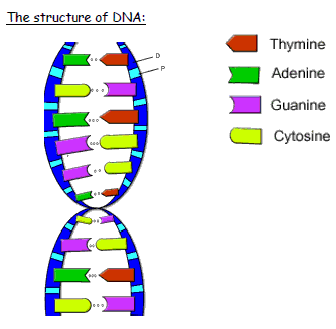
Deoxyribose sugars, a phosphate, and nucleotide base is what DNA is made up of.  The sides of the ladder are made up of sugars and phosphate atomsThe “rungs” of the ladder (DNA) are made up of “bases”. The bases attach to a sugar in the DNA.  Adenine (A), Thymine (T), Cytosine (C), Guanine (G) are the four bases in DNA. Adenine (A) pairs with Thymine (T), and Cytosine (C) pairs with Guanine (G). Hydrogen Bonds are what holds these bases together.


Reflection...

Throughout this unit I learned how important DNA is to living organisms. DNA is the basic blueprint for life.  It holds all your genetic information and without that there would be no you.  DNA has a huge part in determining how the body functions as well. I enjoyed learning the unit.  It was almost like a puzzle, we took pieces of information and finally put them all together and it all kind of clicked. 


Citations:


Olivia Marshall

Recessive traits - Hannah Miller

* Recessive traits in definition is a trait that is carried by either, or sometimes both parents, that is not dominant. What this means is that unless both parents have that recessive trait it will NOT show in the offspring. That happens because Dominant will always overpower recessive if it is present.

* Recessive traits will only show in the offspring in a homozygous recessive relationship. What this means is that both parents carry that recessive trait and it is matched up with the same gene. 

* For example; A bunny is Homozygous recessive for blue fur, (bb) and the other bunny is heterozygous for white fur (Bb).  

As you can see from the image that two out of the four offspring of the bunnies will have blue fur because both parents carry the gene.

*It is possible for a parent to carry the recessive gene, but if it is a heterozygous the dominant trait will be the only trait showing. 

Fun fact! Genetic similarity. People share 7% of genetic material with the E.coli bacteria, 21% with worms, 90% with mice and 98% with chimpanzees.

Summary- All in all I already knew most of this stuff due to having learned about it in a different grade, but it doesn't stop the topic from being interesting. I wouldn't say that I learned anything new, other than that cool fact, but i've dived deeper into the topic and actually learned how to work out Punnet squares.

Citations; N.p., n.d. Web. <https://sketch.io/sketchpad/>. 
"Interesting Genetic Facts." Gene Planet. N.p., n.d. Web. 14 Apr. 2017. <https://www.geneplanet.com/genetics/interesting-genetic-facts.html#>.

Mutation: Substitution

Mutations: Substitution

* Substitution is a mutation that occurs when a base(s) of a nucleotide is exchanged for another.
* This can change the coding of the entire amino acid sequence.
* This is considered one of the more least deadly mutations.
* Substitution Mutation can have a variety of effects. Nothing could happen from substitution because it codes for the same protein or it could cause either an early stop or no stop at all.
* A premature stop badly affects the formation of proteins.
Image result for substitution mutation
Reflection:
In summary, Substitution Mutation can either do nothing to your body or change it completely. Your body can stop making proteins if it causes a premature stop in the coding sequence which surprised me when we were learning about this. It's also kind of easier to determine what kind of mutation happened with substitution because you don't have to count how many nucleotides there are in the sequence. You just have to find out which nucleotide(s) were changed as you read through it. I didn't know about any of this before and when we were learning about mutations in general I didn't think it affected the proteins in the body at all. I though it gave you stuff like six arms or super powers and not give you disease like cancer. This objective was interesting because I figured out why some mutations were less deadly than others. I don't know how this can be applied outside of biology but it could maybe help doctors determine stuff.
"Genetic Code Mutations." SparkNotes, www.sparknotes.com/biology/molecular/geneticcode/section3.rhtml. Accessed 13 Apr. 2017.

Cell Organelle: Vacuoles - Skylar Oliver

Main Ideas:
- Vacuoles are storage bubbles found in cells.
- They are found in both animal and plant cells but they are much larger in plant cells.
- They store food or any variety of nutrients a cell needs to survive.
- They store waste products so the rest of the cell is protected from contamination, eventually the waste products will be sent out of the cell.
- The structure of vacuoles are simple, there is a membrane that surrounds fluid. Inside that fluid are nutrients and waste products.
- Plants may use a vacuole to store water as well. The tiny water bags help support the plant.
- Most of a plant cells volume depends on materials in vacuoles. Vacuoles gain and lose water depending on how much is available to the plant.
- The structure of a vacuole varies according to the needs of the cell.
- It exports any unwanted substances from the cell and isolates materials that might be harmful or threaten the cell.
- They can store proteins/enzymes.
- Vacuoles are also known for helping to maintain the pressure within a cell and the balancing of the pH of a cell.

Reflection: I have learned that when a plant cell has stopped growing, there is usually one large vacuole. Sometimes the vacuole can take up more than half of the cells volume, this is very surprising considering how many other organelles are required in a cell to function properly.

Citations:
- "Difference Between Plant Vacuole And Animal Vacuole". Difference Between. N.p., 2017. Web. 12 Apr. 2017.

- Studios, Andrew. "Biology4kids.Com: Cell Structure: Vacuoles". Biology4kids.com. N.p., 2017. Web. 14 Apr. 2017.

DNA: Structure & Function

DNA: Structure and Function
by Caden Ryan

What is DNA:

DNA, or Deoxyribonucleic Acid, is a nucleic acid that contains the genetic material of an organism as well as control cellular functions. You probably remember the shape of the DNA being a twisted step ladder. This is known as double helix shape, and is was discovered by scientists Watson and Crick in 1953. Its shape allows it to contain lengths of genetic code that helps decide what the organism is and what it can or cannot do. As DNA manages to make up an organism, what comes together to make DNA?

Base Materials:

The main component of DNA is a nucleotide with this composition: Deoxyribose sugar, a nucleotide base(more on that later), and a phosphate. This is similar to ribosomes as they are made up of ribose sugar and the other two materials. While these materials may seem basic, the organization of them are far from basic or simple.

DNA Model:


The DNA model as shown above is organized in a way that genetic traits can be created and an organism can be made. The Sugar and Phosphate are what make up the "struts" of the ladder, more or less seen as a backbone. The Nitrogen bases create the "rungs" and this is where the varying traits are made. Although there are only four nitrogen bases: Adenine, Thymine, Cytosine, Guanine; the organization of these bases and(more importantly) their pairs decide what organism anything is. The matches are Adenine to Thymine and Cytosine to Guanine as shown below.


Reflection:

Being taught this material, nothing really new at first jumped out at me at first. I had known about the four bases and how they connect, but the real depth that went into the lesson was really well done. Good explanation was put into the explanation of the materials that made it up and how the four bases work in varying organisms. How this can actually help outside Biology is possibly in some trivia tournaments or even relating other topics like say romantic relationships are somewhat similar. I don't really know, maybe creative interpretation was what DNA holds for you instead of me. Whatever it may, now you know DNA.


Citations:
http://www.delhidailynews.com/news/DNA-is-not-static--it-constantly-wiggles---morphs-into-different-shapes--study-1444713495/
http://biosocialmethods.isr.umich.edu/epigenetics-tutorial/epigenetics-tutorial-genome-structure/

Mitochondria

Chloe Russell

Main Ideas:

          1) Known as the powerhouse of the cell
          2) Chemical reactions happen in the mitochondria that produce energy for the cell
          3) Has a folded inner membrane that has a large surface area so it can produce more                       energy
          4) Has its own DNA

Reflection:

          Mitochondria is a very important organelle that produces energy. Mitochondria are found in both plant and animal cells. Mitochondria are found in the cytoplasm. It has a folded inner membrane called cristae that helps it produce more energy. I was surprised to find out that Mitochondria has DNA in it. I had previously learned about Mitochondria, but I did not know that cells that need more energy (ex: muscle cells) would have more mitochondria than other cells. 


Citations:

k, amithbabu, and View profile. "MITOCHONDRIA- DEFINITION-STRUCTURE- FUNCTION". Biozoomer.com. N.p., 2017. Web. 14 Apr. 2017.("Unit 2: Mr. Black's Biology Class")

Plant vs. Animal Cells

Plant vs Animal Cells                                                Natalie White

Summery 

Plant and animals have many similarities such as the nucleus, however they also have many differences such as the cell wall. Both cells have the same job, to transport nutrients and break them down, provide support to the organism and control chemical reactions. Plant and animal cells have 3 main differences vacuole size, chloroplasts and a cell wall. The plant cell however is able to make and transport its own nutrients through the process of photosynthesis. Photosynthesis is the process of converting light, water and carbon dioxide into sugar the bi-product oxygen. This process is carried out by chloroplasts and chlorophyll which traps the sunlight. Animal cells however can not make their own food and must take in nutrients. Plant cells also contain a cell wall, made of cellulose which is located outside of the cell membrane and support the shape of the cell and also control what enters and exists the cell.  The plant cell vacuole is also bigger because it holds the nutrients needed in photosynthesis.

Organelles

Plant cells -
  • The organelles in plants and animals are the same with the following exception
  • Plant cells have no lysosomes or centrioles
  • Plants have a CELL WALL - made out of cellulose - rigid and tough - square or rectangle - cell wall is outside of the plasma membrane - controls what goes in and out of the cell
  • Plasma membrane takes on the same shape as the cell wall
  • Discovered by Hooke
  • The cell wall remains after the cell dies
  • Plastids - store food and sometimes helps make food
  • Chloroplasts - green color - carries out photosynthesis
  • Chlorophyll which traps the sun’s energy
  • Vacuoles in plants are much larger than in animals

Animal cell -

  • Cell membrane
  • Cytoplasm - streaming
  • Nucleus - nucleus membrane - nucleus
  • Endoplasmic reticulum - smooth and rough
  • Mitocondria
  • Vacuole
  • Lysosomes - enzymes
  • Golgi apparatus
  • Centrioles


Samson, Stacey. "Plant Cell Vs Animal Cell | What's The Difference?". Difference Talk. N.p., 2017. Web. 14 Apr. 2017.

Reflection - I had learned a lot about plant and animal cells, the organelles and functions, from previous science classes however I did learn a little more depth into the photosynthesis process such as plastids and about the differences in rough and smooth endoplasmic reticulum. I like learning about plant and animal cells so I thoroughly enjoyed the unit.


Outside of Science - One way you can use your knowledge of plant and animal cells is in gardening because you know that the plant must have sunlight, water and air to survive and thrive.

Scientific Method

The scientific method is a process for experimentation that is used to explore observations and answer questions. 


Step 1 (Question): 
Create a question and think about what you hope to discover during the process. Think about what question you would like to answer. Your question needs to be about something reasonable and will typically start with words such as what, when, where, how or why.

Step 2 (Research): 
Use resources to perform background research on your question; gathering information will help prepare you for the next step in the Scientific Method.

Step 3 (Hypothesis):
Using your background research and current knowledge, make an educated guess that answers your question. Your hypothesis should be a simple statement that explains what you think might happen.

Step 4 (Experiment):
Step by step, conduct an experiment that tests your hypothesis. The experiment should be a fair test that changes only one variable at a time while keeping everything else the same. Repeat the experiment to be sure that your results are accurate.

Step 5 (Data): 
Collect data and record the progress of your experiment. Be sure to  document your results with detailed measurements. Include descriptions and observations in the form of notes, journal entries, photos, charts or graphs.

Step 6 (Conclusion): 
Analyze the data you collected and summarize your results. Use your data to help answer your original question. Ask yourself, do the results of your experiment support or oppose your hypothesis?

Step 7 (Communication): 
Present your final conclusion!


Reflection: 

This is something I learned when I was younger, and I have not learned anything new from it. I like this objective because it is very helpful, and you can use it outside of biology. It can be helpful in everyday life! 

Citations: 
https://www.pinterest.com/bwilliams1210/stem-scientific-method/

Thursday, April 13, 2017

Chloroplasts Carter Gamble

Image result for chloroplast
Main Ideas:
- Chloroplasts are found only in plant cells, not animal
- Made up of stacks (granules) of thylakoids encased in a membrane
- Main purpose of a chloroplast is to convert sunlight into energy in the process of photosynthesis
- Green color comes from chlorophyll

Reflection:
In the topic of chloroplasts I already I knew most of the information concerning their function, since they are so important in plant cells. It is still amazing to me that something that simple could create its own energy just with the sunlight. In our lessons on chloroplasts I have learned about their anatomy and function. This is very important information mostly in biology but could be possible used in the field of solar energy to make advances.